
How Foster City Residents Are Found
Name the question first. That is how a productive Foster City residents directory search begins. Who owns a parcel? The San Mateo County Assessor and the county Property Maps answer that one. A recorded transfer points instead to the ACRE grantor-grantee index, which picks up where the assessed owner leaves off. Someone checking their own registration uses the California or county voter-status form. That form is not a public name list. Each public name lives with its own keeper, whether it is a court party, a permit contact, a business officer, a probate heir, or a historical subscriber.
Corroboration is what makes a trail strong. A parcel yields an APN and a legal description. A deed names parties and carries a recording date. A permit adds dated work and public contacts, and a directory or obituary may supply a past-household clue. No single record proves that everyone at an address lives there now. The county roll names an assessed owner, while a city permit names a project and its contacts. Keep those roles straight as you go.
- Start with the address or name you know, and decide whether the goal is ownership, a public case, a family link, or an older household.
- Use San Mateo County Property Maps to capture the parcel, APN, and recorded-map links.
- Compare the parcel with the assessment roll, then search the owner as a grantee in the deed index.
- Use the right state or county form for voter status and vital records. A self-lookup is not a street browse.
- Finish with the library, court clerk, City Clerk, or a California Public Records Act request when the online index stops.
Where Foster City Keeps Resident Records
Foster City records live on more than one shelf. The City Clerk at City Hall, 610 Foster City Boulevard, manages municipal legislation. Public searches go through the city Laserfiche portal or a California Public Records Act request. The county side is bigger. San Mateo County ACRE holds the assessor roll, maps, recorded documents, and county clerk filings. It also covers vital records and elections functions. The Superior Court in Redwood City handles Foster City civil, criminal, family, probate, and small-claims matters. Traffic cases go there too.
San Mateo County ACRE
555 County Center
Redwood City, CA 94063
650-363-4500
San Mateo County Assessor
555 County Center, third floor
Redwood City, CA 94063
650-363-4500
Foster City City Clerk
610 Foster City Boulevard
Foster City, CA 94404
650-286-3200
Sometimes a web result names a document but stops short of its image. That is when the ACRE counter and its public terminals matter. The City Clerk is the fallback for municipal writings. Case copies come from the county court clerk and Records Management. Each keeper decides what stays public, what gets redacted, and what needs a written request. The County Clerk-Recorder service page lays out the county office route for recorded documents. It also covers related filings.
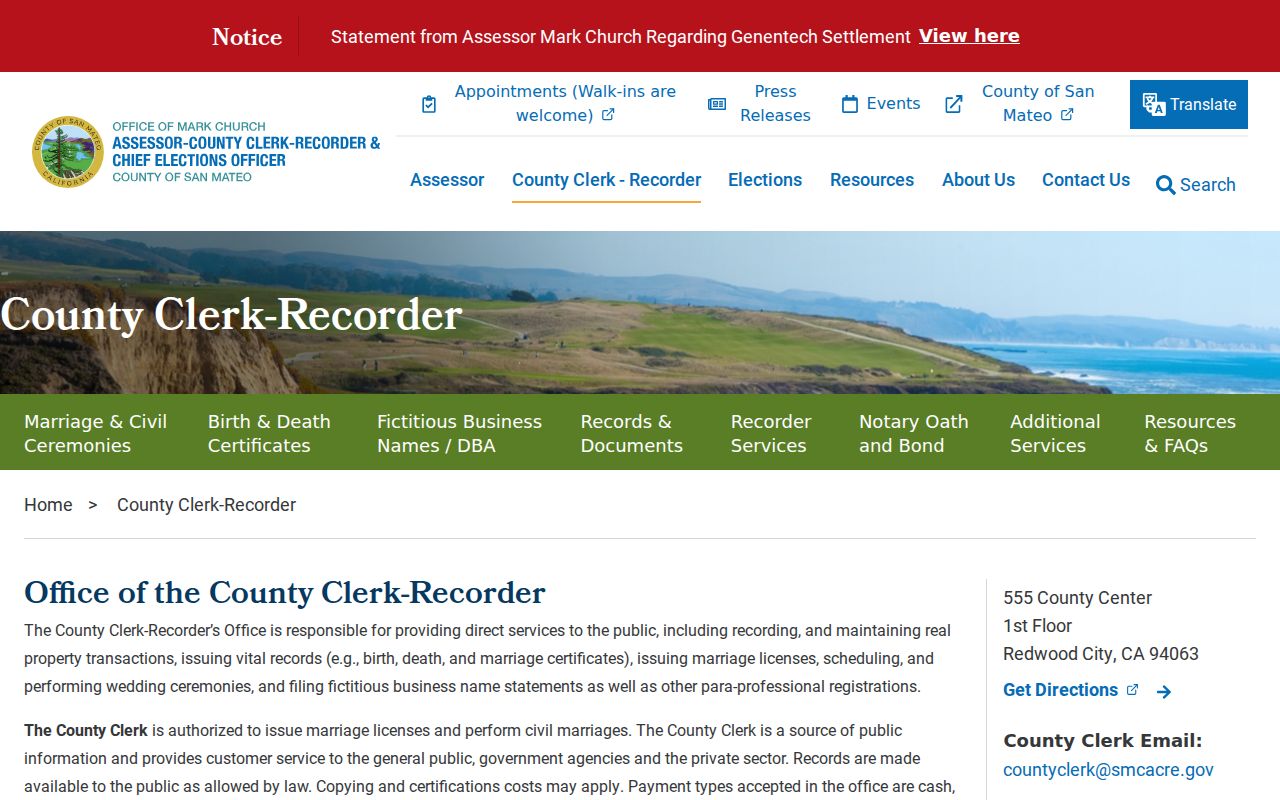
The county office serves as records custodian for many property and civil filings. A service page is only an orientation point, though. Take the named record type. Follow its current request channel. San Mateo County Assessor information identifies the office behind the assessment roll and property questions.
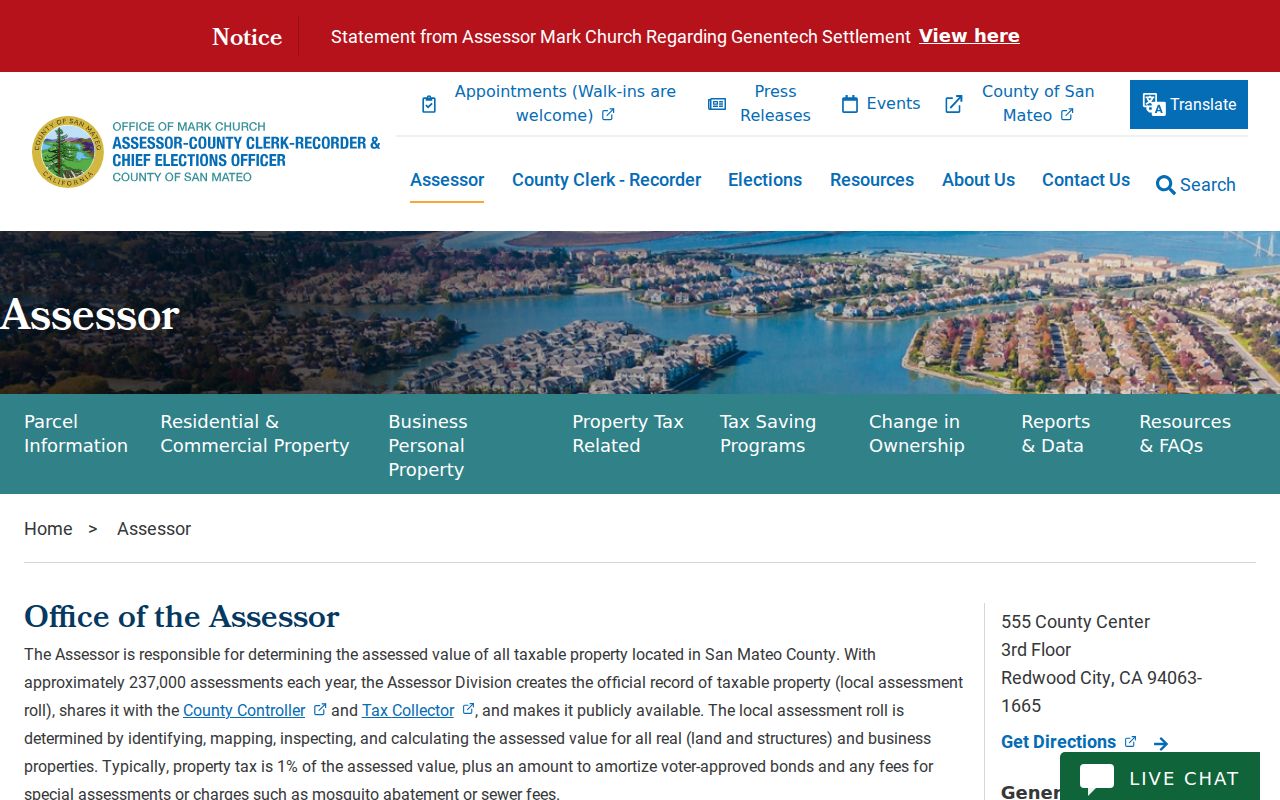
That distinction keeps things honest. A property source stays tied to its county custodian rather than to some imagined citywide roster.
Foster City Has No Official Resident List
No legitimate roster of every Foster City resident exists. An assessed owner may live elsewhere. A tax mailing address may belong to a trust or an agent. It may also point to a business or a second property. A permit contact is tied to a project, not a whole household. The voter-status form lets an individual verify their own registration. It exposes no public name-and-address directory.
Access limits are spelled out in law. California Elections Code §§2180-2194 restrict voter-file access. They also demand a permitted purpose for any file product. California's Safe at Home program gives qualifying participants a substitute mailing address for protection. Public records answer narrow questions well. They should never be stitched into a claim about an unlisted occupant. The useful Foster City residents directory is really a set of source-specific trails.
Foster City's own records page explains the city portal and the request form. It also covers the exemptions under Government Code §§7920.530, 7920.545, and the provisions beginning at §7927. Personnel and medical writings may be withheld. Such records would invade privacy without justification. The city records and CPRA page shows how a portal search works. It also shows how a CPRA request fits together with one.
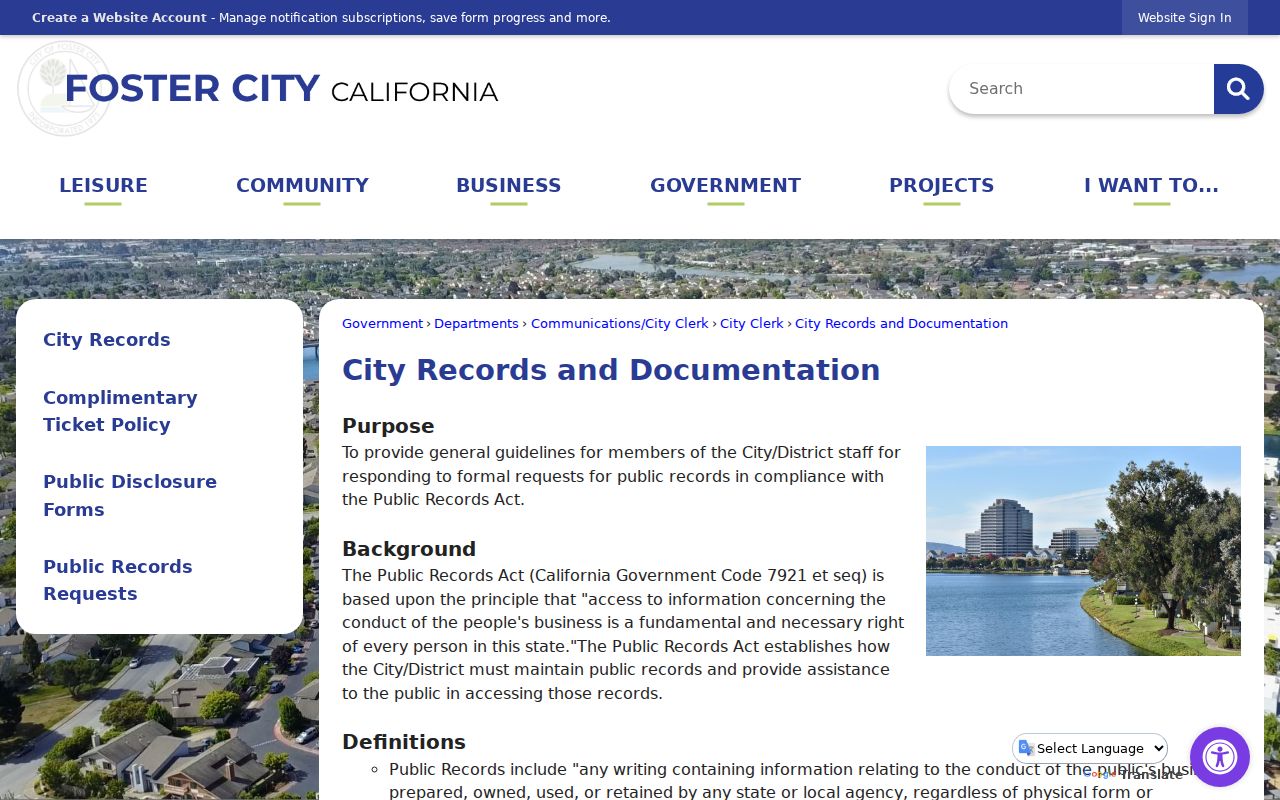
Use the portal for anything already published. Use the City Clerk when a municipal record needs a formal request or clarification. That boundary is practical, not just legal. Treat a search result as a pointer to a custodian record, then ask what the record actually establishes.
Map a Foster City Address
Start with the parcel. The county Property Maps service accepts a street address or an APN. It also takes an assessor map book and page, or a recorded-map volume and page. A result can display the APN and the parcel outline. It also shows an assessor-map link and any recorded maps on file. Write those identifiers down before you chase a name.
Foster City grew from reclaimed Brewer Island land. It was platted by tract and neighborhood rather than a tidy grid. Lagoons, bridges, condominiums, and shared parcels can wreck a guessed sequence of house numbers. The legal description and APN give you steadier keys. They beat a postal label or a landmark.
The county map instructions explain the parcel and recorded-map search modes that apply to Foster City. Treat the map layer as a record locator, not a resident list. It points you to the right custodian. That way a records request does not go to the wrong office.
The county assessor online-services page sits alongside the maps. It serves as a starting point for assessment and property-tax tools.
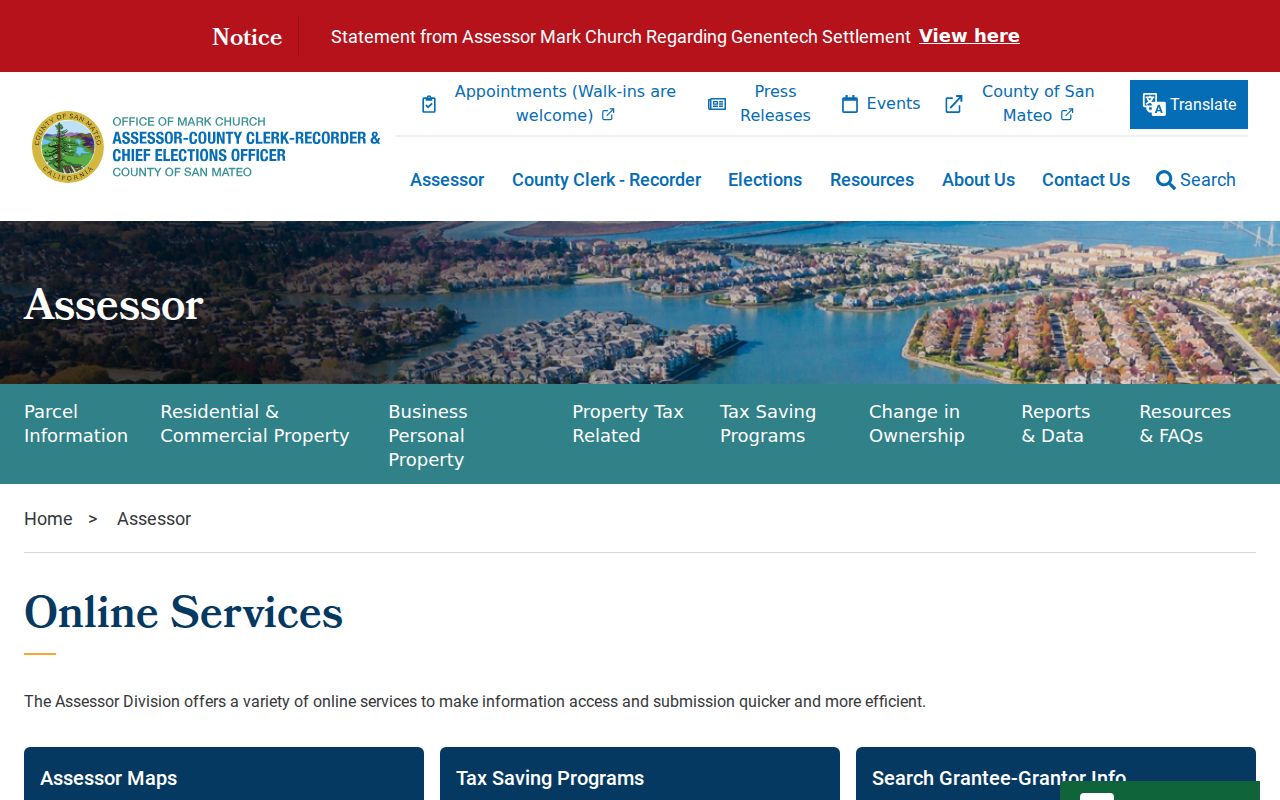
Use the map first when the address itself is uncertain. Once it resolves, read the roll as an assessed-property record rather than a household list. After the APN is in hand, the Foster City street directory workflow walks the full street-by-street parcel chain.
Compare the physical situs with any tax mailing address at that point. The two may match. A mismatch still proves nothing about where an owner or anyone else actually lives. County parcel data keys on the situs address as the location, and that distinction keeps a name search tied to the correct lot, tract, and unit.
Foster City Deeds from Owner to Owner
A recorded-document index builds a legal ownership trail one transfer at a time. Search the current assessed owner as grantee. Note the document number, date, grantor, and legal description. Then search that grantor as grantee in the earlier period. Walk backward while checking the APN and tract description at every step. The index is free to use, but its web database withholds document images for privacy. Copies are ordered separately or read at public terminals.
The ACRE grantor-grantee entry page is the right first stop. A recorded deed confirms a party to a transfer, not continuous occupancy. Liens, reconveyances, and other filings surface here too. So read the document type before treating a hit as an ownership change.
The recorder offers a mail-copy route through its customer service desk. A request needs party names, document type, recording date, recording number, payment, and a self-addressed stamped envelope. Regular recorded copies run $5 for the first page of each document. Add $1 per additional page. Certification costs $5 more. Confirm the current fee before you send payment.
Inside the Foster City residents directory workflow, the deed trail answers who held title and when. It does not name every person who lived on the parcel. Note: Preserve the document number from any deed index hit and obtain the image before drawing a conclusion from a party name.
Foster City Permit History by Address
Foster City's eTRAKiT permit search adds a dated municipal layer to the property trail. The public form searches by address or by permit and project number, with company or license number options in related modules. Each result opens through tabs labeled Permit Info, Site Info, Contacts, Fees, Inspections, Chronology, Conditions, and Reviews.
The Foster City permit search shows every field and tab a researcher can use with no account at all. Applying and paying is what requires an account; the public search stays free. The Building Division lists cddpermit@fostercity.org and 650-286-3227, with counter hours Monday through Friday, 8 to 12 and 1 to 4:30.
One sample record, 601 Teal Street A under activity BLDG2022-0630, lists a type and subtype, description, status, application and issue dates, final or expiration dates, address, APN, subdivision, tract, block, lot, neighborhood, lot size, related permits, attachments, inspections, and chronology. That inventory makes eTRAKiT genuinely useful for house history. A named contact is a project contact, though, not proof anyone lived there.
For houses built before 1972, the city warns that original plans may be missing. At incorporation, the county handed Foster City microfilm copies of building-permit applications and only limited site plans. A CPRA request can still be worth a try, but record the gap rather than papering over it with guesses.
Today's Foster City Resident Sources
Current sources only look like directories when their scope stays clear. A property roll lists assessed ownership. The voter tool confirms one voter's own status. A deed index lists parties to recorded documents. City Laserfiche can surface public municipal writings. Business and license portals show public roles and addresses of record. Each source answers a different question about a Foster City address or name.
| Source | What It Can Confirm | Keeper | Access |
|---|---|---|---|
| Assessment roll | Assessed owner, APN, values, exemptions | San Mateo ACRE Assessor | Public roll and summaries |
| Grantor-grantee index | Recorded parties and document trail | County Recorder | Free index, image by order or terminal |
| eTRAKiT | Permit contacts, dates, inspections, site/APN | Foster City | Free public search |
| Voter status | One person's own registration status | California SOS and ACRE Elections | Self-lookup or statutory file request |
| Business and license files | Entity, agent, license, or public role | California SOS or DCA | Free public search, some copies extra |
The Assessor online-services page is a sensible county starting point. It publishes no unrestricted owner-name search. The State Controller's Unclaimed Property search can corroborate a past name-and-place association. A claim still demands proof of entitlement. Keep these sources in a careful record trail rather than one blended profile. The county's annual roll summaries add context to the assessment source. They sit within a large county record system.
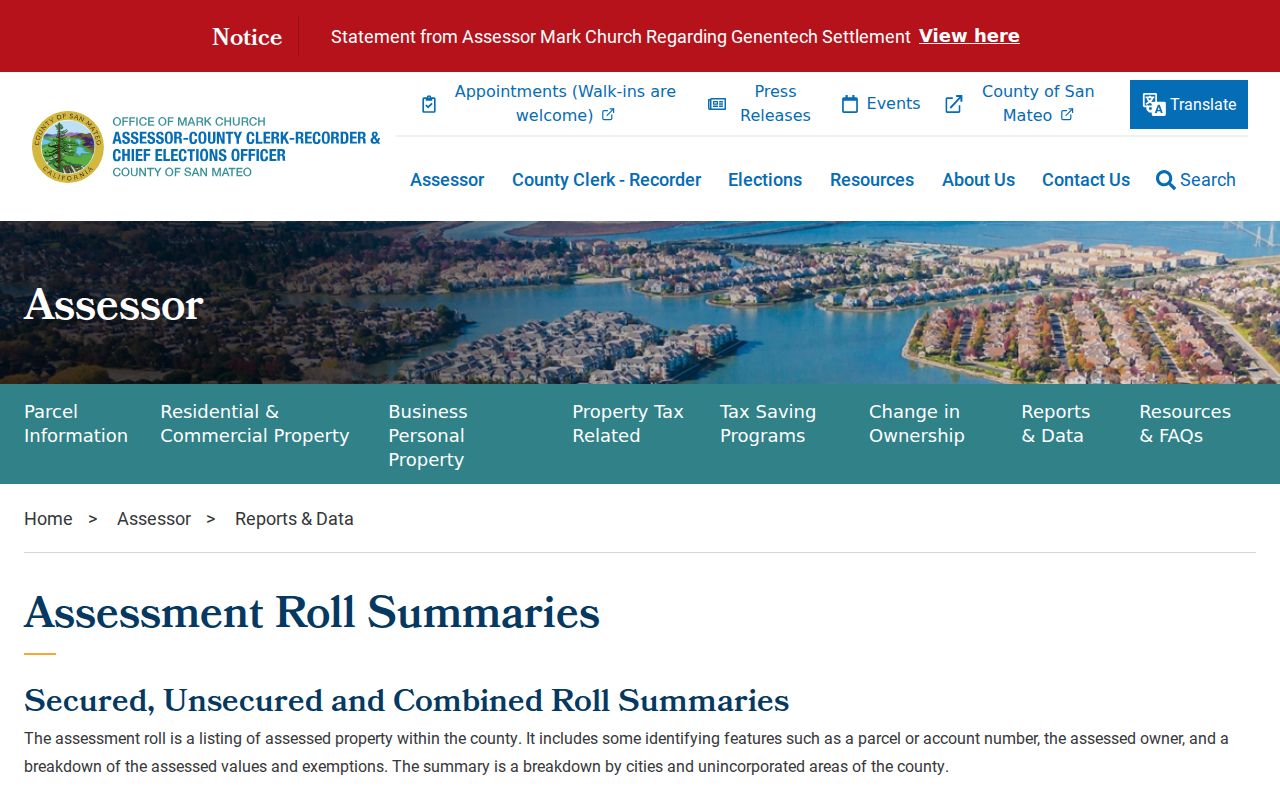
A roll summary describes scale and categories. It cannot replace the parcel-level record or establish occupancy.
Foster City Voter Status and Privacy
California builds its voter tools around a person checking a single record. San Mateo County's My Election Info form asks for a house number, ZIP code, and birth date. It returns nothing before all three are entered. The response covers registration status, party affiliation, precinct number, and election information. There is no name field. And no way to browse a Foster City street.
| House number | Text field; use the number only. |
|---|---|
| ZIP code | Five-digit number for the voter lookup. |
| Birth date | Month, day, and year selectors. |
| Result labels | Registration status, party affiliation, precinct number, and election information. |
San Mateo County's voter self-service form shows where the privacy line sits. A full voter-information file takes a written application, payment, requester details, and a permitted purpose such as election, scholarly, journalistic, political, or governmental use. The county prices the file at $125, with printed lists at $0.50 per 1,000 voters. Current forms and rules control. For a state-level self-check, California's voter-status page pairs neatly with the county form.
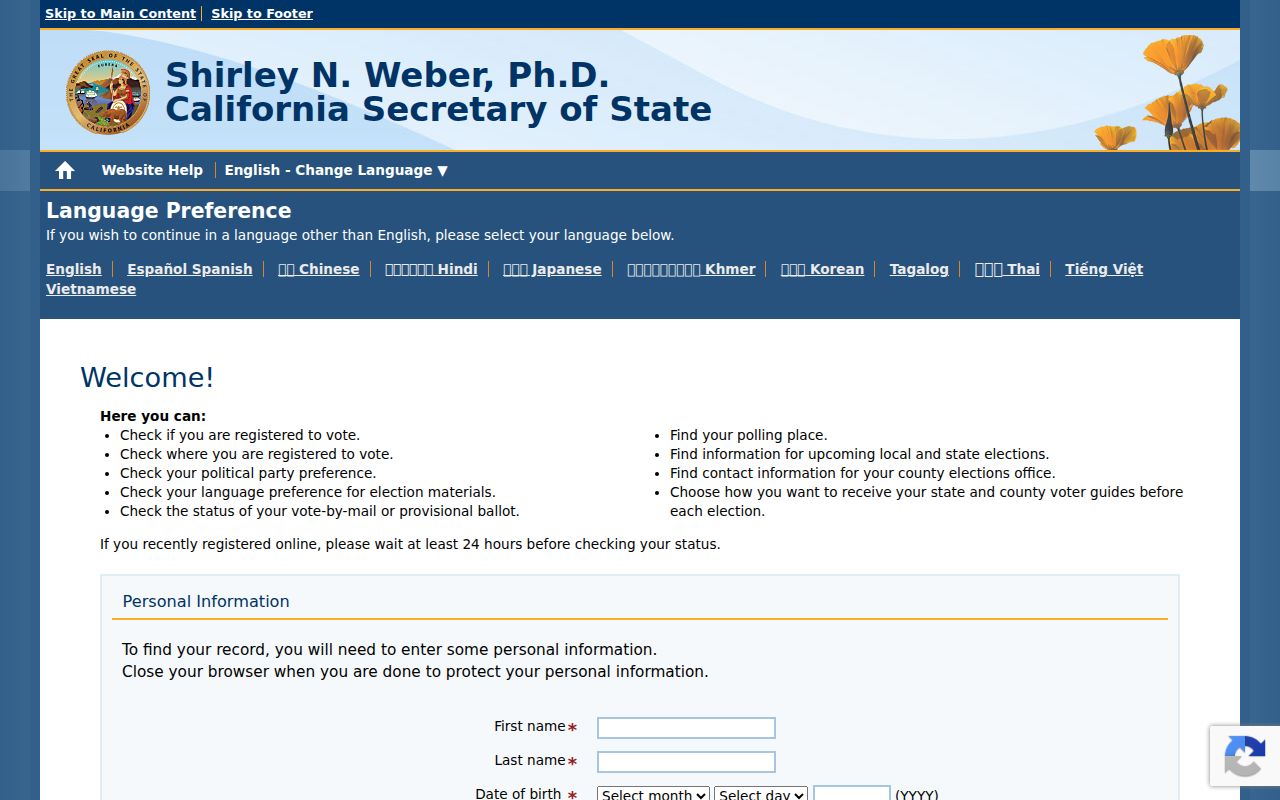
The state form confirms one individual record only. It does not turn voter data into a public residents directory. Driver-license and Social Security numbers, signatures, and protected addresses remain confidential. Safe at Home protections override ordinary address assumptions. A Foster City residents directory should never stretch a self-lookup form into a public block roster.
San Mateo Court Trails for Foster City
Foster City cases run through the Superior Court of California, County of San Mateo. The MIDX index splits matters by type. These include appeals, civil, criminal, family, probate, and small claims. Person Search takes first and last name fields with a two-character minimum. Case Number Search requires at least five alphanumeric characters. Filing Date Search caps ranges at five calendar days. San Mateo MIDX returns case numbers, case names, filing dates, party types, and source divisions. Odyssey adds registers of actions. These cover nonconfidential, nonsealed civil, criminal, family, probate, small-claims, and traffic matters. Adoption, juvenile, mental-health, sealed, and confidential material stays absent or restricted. A public index is not the filed record. The Superior Court online-services page lists the separate case systems that serve Foster City.
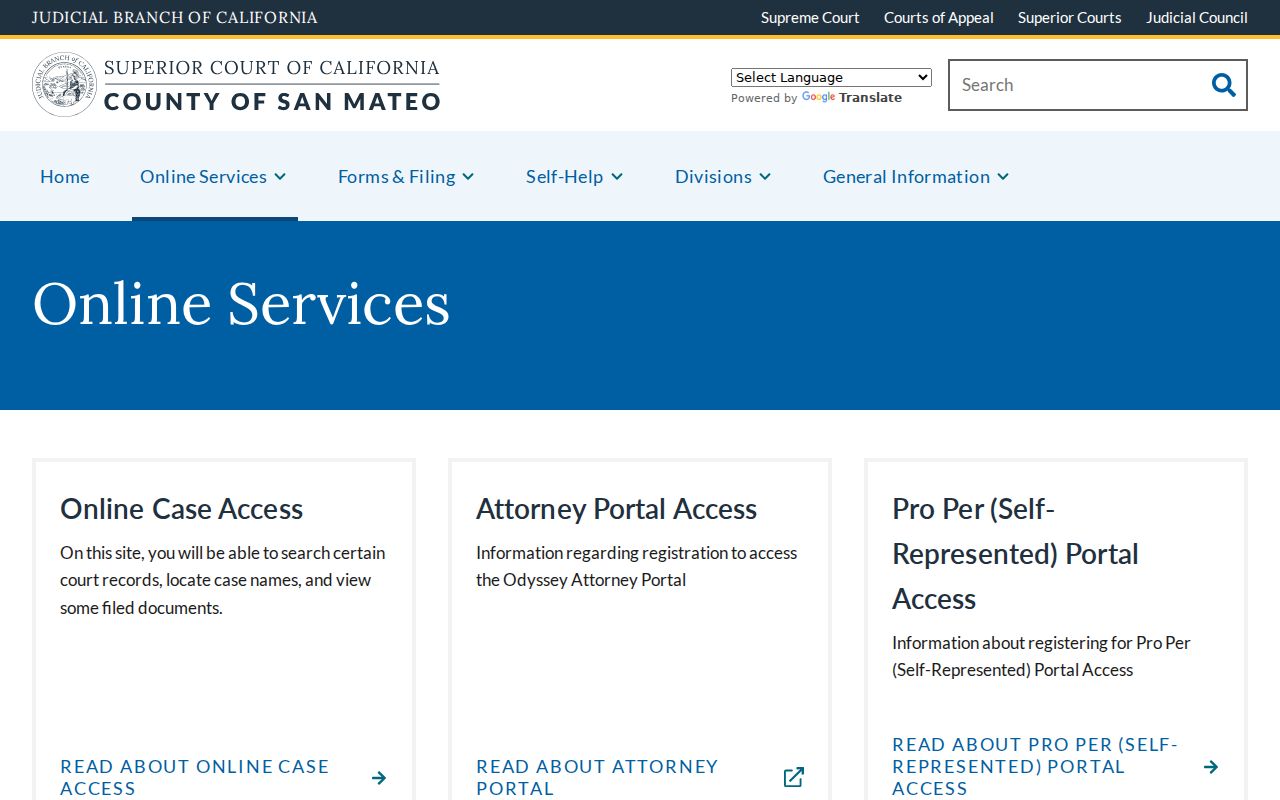
Pick the right case module before searching. Then request the register or file when the index alone falls short. For copies, the court wants a case number, the parties, an approximate filing date, and a description of the document. Records Management sits at 400 County Center, first floor, Room A, in Redwood City. It accepts mail-copy requests with a postage-paid envelope. The check should be blank and marked with a not-to-exceed amount. The court promises a response within 30 days. It will not conduct research for you. Federal matters belong to PACER for the Northern District of California. Keep local and federal dockets distinct. Before deciding two entries describe one person, compare names with a date. A role, location, or linked parcel can settle the match.
Foster City Paths for Heirs and Classmates
A person-focused search often needs a record that was never designed as a resident list. Probate filings may name a decedent, petitioner, executor, administrator, or heirs. California adoption information stays confidential. It belongs with authorized state channels rather than a public resident index. Yearbooks, library databases, school archives, and newspapers can help reconnect former classmates. Business and professional records separate a public role from a private address. California bizfile Online searches entities by name or number. It may show formation, status, jurisdiction, addresses, agent, and statements of information. The Department of Consumer Affairs search narrows a license by name, number, city, type, board, status, or discipline. A registered agent or address of record is not proof of residence.
An entity result can identify an organization and its filing role. It should not be recast as a private address record. The Department of Consumer Affairs license search verifies public professional records.
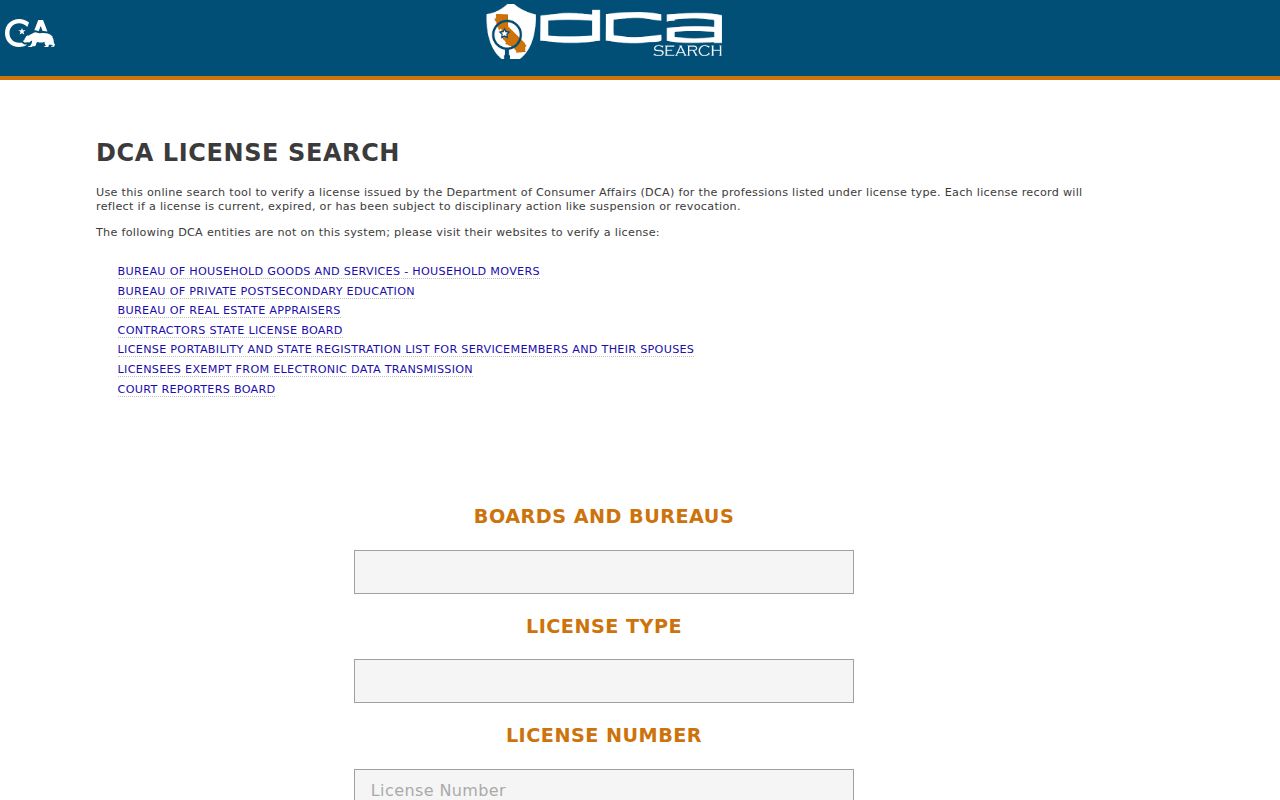
License details attach a public credential or role to a name match. They still need a separate address or date check. The State Controller's Unclaimed Property search accepts a last name or business name, first name, city, ZIP code, and property ID. Searching is free, though a claimant must prove identity and entitlement. A public result may support a past association; it does not establish a current home. The State Controller's unclaimed-property search is a free state source. It offers a name and place clue.
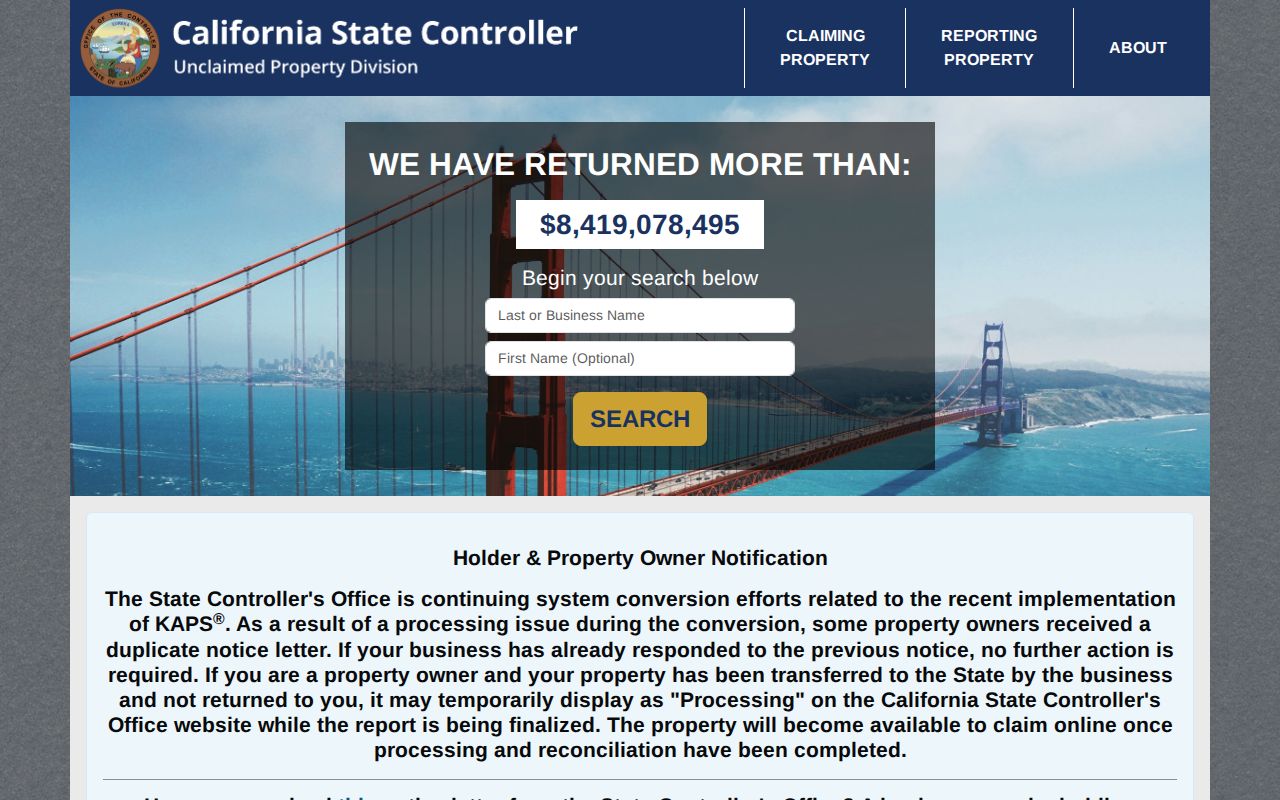
Use it as a lead for an heir or former name. Then prove the relationship through the custodian's claim process. A Foster City residents directory works best as a set of leads. It is not a source of final answers. Verify a family link in the filed probate petition. Check a classmate in a dated yearbook. Confirm a business connection in the official entity file.
Foster City's 1958 to 1971 Record Divide
Foster City barely existed before the Beatles formed. T. Jack Foster and his partners secured an option on Brewer Island in 1958. Reclamation and construction accelerated in 1961. The first homes were finished in 1963, and the first residents moved in the following year. Incorporation came on April 27, 1971, and City Hall opened in 1972. Any name older than that belongs to Brewer Island or San Mateo County. It does not belong to Foster City proper. The official Foster City history spells this out. That is why a nineteenth-century city directory search simply does not fit here. For the 1960s, county land records, development maps, builder names, and early telephone books carry much of the load. Permits, newspapers, and oral history help too. A planned community leaves its earliest paper trail in tract and infrastructure records. It rarely sits under a city heading.
Builders matter as search keys. Eichler Homes, Duc & Elliott, and Kay Homes all appear in the cultural-resources material. Tract and neighborhood terms can work alongside a street address. The community profile counts roughly 2,600 acres and nine original residential neighborhoods, developed one after another. To go deeper, the Foster City city directory collections page follows the telephone books, regional directories, census records, maps, and Historical Society sources. None of them is a modern resident roll.
Official Rolls and Compiled Directories
An official roll and a compiled people-finder are different animals. The official roll has a named custodian, a fixed field set, and an access rule. A compiled product may merge public and licensed data. It may lag behind on updates. Or it may fuse two strangers who share a name. Errors get fixed differently too. A wrong official entry is corrected with the office that issued it. A wrong compiled entry takes a separate correction request to the publisher.
| Path | Strength | Limit | Best next check |
|---|---|---|---|
| County roll or map | Parcel and assessed ownership | Not a household list | Deed and legal description |
| City permit file | Dated project and site details | Contact is not an occupant | APN and permit chronology |
| Library directory | Name, address, and past context | Canvass date and omissions | Adjacent year or newspaper |
| Compiled directory product | May gather many clues | Mixed sources and stale matches | Original custodian record |
Check the free official index before anything else. A certified copy is worth paying for only when a formal record or proof demands it. A narrower source that states its scope and date plainly can still carry more weight than a broader one that hides them.
Foster City Requests and Protected Addresses
The California Public Records Act, Government Code §§7920.000 and following, opens access to nonexempt state and local writings. Agencies normally decide within 10 days. Unusual circumstances allow a written extension of up to 14 days more. Inspection is generally free. Duplication or specified electronic work can carry a charge. The CPRA never forces an agency to create a new record or answer a question no record answers.
Foster City's Laserfiche portal is the first stop. If the writing is missing, file the City Clerk's request form and describe the date, department, record type, address, permit, or council action. For a deed image, follow ACRE's copy procedure. Court files go through the court's own copy route. Vital records require the current county or CDPH form and its eligibility rules.
Lawful personal use. Public availability does not permit stalking, threats, harassment, or intimidation. California Penal Code §646.9 and related laws can apply; protected addresses, sealed files, voter identifiers, and DMV information must not be reconstructed from other records.
California Safe at Home guidance describes the substitute-address program for qualifying survivors and certain public-facing workers. A responsible Foster City residents directory honors a custodian's redactions and stops at any protected record.
Directory Jargon for Foster City Searches
The same labels appear across the county portals, yet they rarely mean the same thing. Read a field label closely before assuming what a result proves.
- Roll
- An official list maintained for a defined purpose, such as assessment or voter registration.
- Index
- A pointer to a source document. A deed or court index entry is not the full image or file.
- Parcel
- A mapped unit of land identified by an APN, with a situs and legal description.
- Criss-cross directory
- A street- or address-ordered directory used to move from a place to a name, when a local run exists.
An APN never changes its spelling the way a street name can. In Foster City, the parcel number and tract description anchor a property far better than a hand-written avenue name. A residents directory result only holds up when it rests on those fixed identifiers.
Foster City Directories from Earlier Years
Older Foster City research starts with regional collections. The San Mateo Public Library California Collection holds San Mateo city directories reaching back to the 1900s, plus local maps, Sanborn maps, newspaper microfilm, and clipping files covering the 1940s through the 1960s. The San Mateo County Historical Association keeps books, ledgers, manuscripts, newspapers, photographs, and objects from about 1830 onward. Together these shelves frame any past residents search in Foster City with real context.
Telephone books give the spine. The Library of Congress holds San Mateo County volumes from September 1951, September 1953, April 1957, April 1960, April 1973, and April 1976. The earliest ones predate modern Foster City residents entirely. The 1976 book can show a subscriber name, a street number and name, the locality tag "Foster Cty," and a phone number. It cannot list every household member or mark ownership. Treat it as a lead, not a verdict.
San Mateo County Libraries genealogy resources open more doors. Ancestry Library Edition works inside a library building. HeritageHub covers obituaries and death notices. HeritageQuest carries census material. Access varies by card and location. The Foster City Historical Society adds oral histories and living-memory artifacts for a planned community whose paper trail really begins after 1958.
A sound method pairs the old volume with something harder. Confirm each name and address against a deed, permit, probate file, or newspaper record. The directory shelf supplies leads and context, never a complete current resident list. The county clerk also keeps historical ancillary indexes, including the naturalization index covering records dated 1800 to 1991, which can pin down an identity the telephone book only hints at.
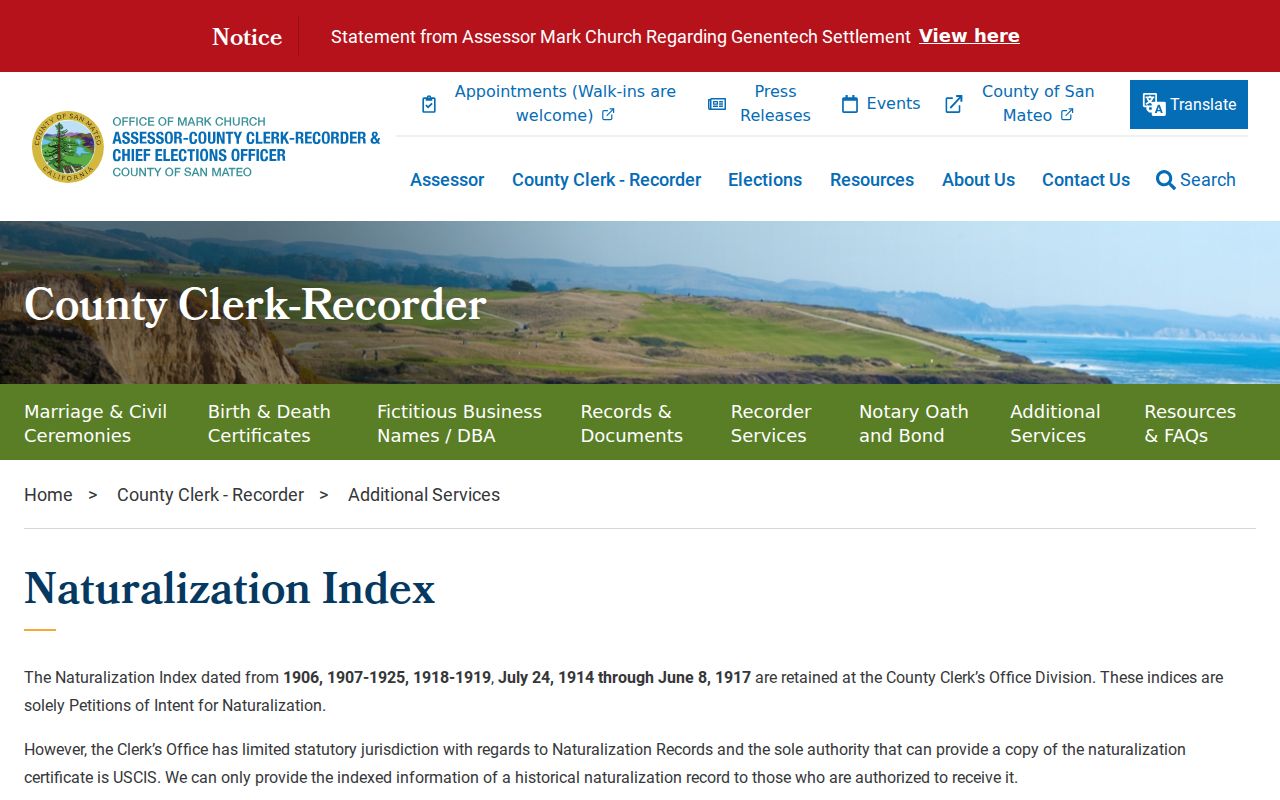
Ancillary records can corroborate an older name from a Foster City residents directory. Search each one for its own public purpose, not as a shortcut around it.